Shade Is Allocated: How to Read Your County's Heat-Response Playbook
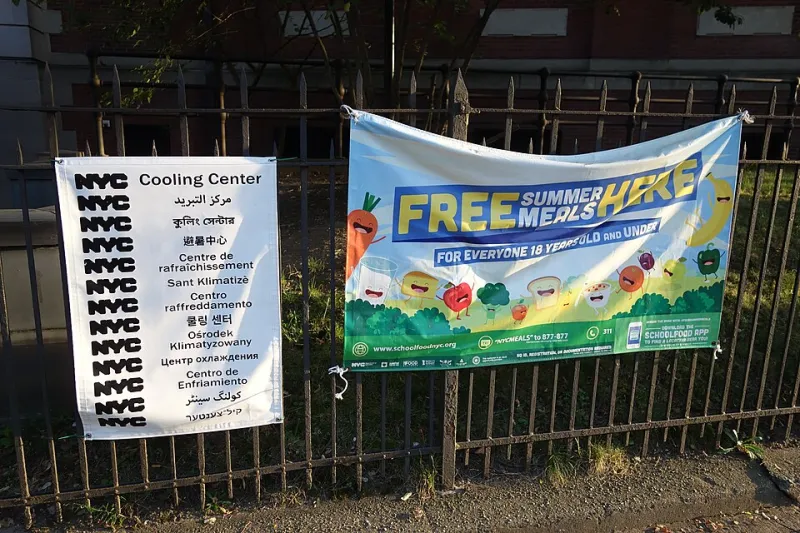
Photo: Tdorante10, CC BY-SA 4.0, via Wikimedia Commons
It is 2 p.m. on a July afternoon, the heat advisory has been extended again, and you do what a lot of people do: you search for cooling centers near me. Up comes a county webpage with a tidy list of libraries, senior centers, and recreation buildings. It looks like a public-service announcement. It reads like one, too. But that list is not just a courtesy. It is a budget with addresses attached, a staffing plan with hours, and a map of who the county thinks is worth keeping cool.
That is not a knock on the people who put it together. It is a reminder that heat response is a policy choice, and policy choices leave paper trails. If you want to understand why the library two blocks from your apartment opens at 10 and closes at 5 while the rec center across the highway stays open until 8, the answer is probably not the weather. It is money, liability, transit, staffing, and a set of criteria that may never have been explained to the public in plain language.
Start With the Plan, Not the Map
The cooling-center list is usually the last page of a longer document. Before you study the addresses, find the plan behind them. Search your county's website for terms like heat response plan, excessive heat annex, or emergency operations plan heat. Check the public health department and the emergency management agency, not just the parks department. Then look at the meeting packets for the county board of health or the county commission. Heat plans often get approved as part of a broader emergency operations update, which means they can slip through with little discussion.
Read for three things: the trigger, the decision-maker, and the activation sequence. What heat index or temperature actually causes the county to open sites? Who makes the call, and how quickly? Is it the health officer, the emergency management director, or a committee? Does the plan require a certain number of consecutive days, or does it open the moment the National Weather Service issues an excessive heat warning? These details determine whether the list is a real resource or a press release.
The List Is a Siting Decision
Now look at who is on the list. Libraries are common because they already have air conditioning, staff, restrooms, and public seating. Senior centers make sense for older residents. Recreation centers have space and sometimes showers. Community colleges and churches show up when they have a willing host and a memorandum of understanding. Splash pads and pools are sometimes listed, but they are not the same thing as a cooled indoor room, especially for someone with a medical condition or a pet.
Then look at who is missing. Is there a gap in the neighborhood with the least tree canopy and the most asphalt? Is the only site on that side of town a building that closes at 4 p.m.? Does the list include a site that is not on a bus line? The county may have good reasons for every omission: insurance, ADA compliance, staffing shortages, a lease that does not allow public use, or a host site that backed out in June. But those reasons are not always written down where residents can see them.
Ask for the siting criteria. Ask for the list of sites that were considered but not selected. Ask whether the county has a formal agreement with each host site and whether those agreements are public records. In many places they are. A records request for cooling-center site agreements, transportation contracts, and staff overtime costs can turn a vague map into a concrete picture of what the county is actually willing to spend on heat.
Hours, Transit, and the Fine Print That Decides Who Shows Up
A cooling center is only useful if a person can get there, get in, and stay long enough to cool down. That sounds obvious, but the details are where heat plans fail quietly. If the site opens at 9 a.m. and closes at 5 p.m., it does not help the roofer who gets off at 6, the night-shift worker who sleeps during the day, or the parent who needs to pick up kids at 3. If the site is three miles away and the county has no ride voucher, the list is a map of good intentions.
Look for transportation details in the plan. Does the county reroute a bus, offer paratransit, hand out gas cards, or contract with a rideshare service? Does the local transit agency waive fares on heat days? Are there any sites open overnight, and if not, what is the plan for people who have no cool place to sleep? Check the fine print on pets, identification requirements, and language access. A sign-in sheet that asks for a state ID can be a barrier for people who are homeless or undocumented. A site that does not allow pets forces people to choose between their animal and their health.
These are not hypothetical concerns. They are the questions that separate a list that looks good in a newsletter from a list that actually gets people out of the heat.
Follow the Money
Heat response is funded through a patchwork. Some counties use general fund dollars. Others rely on public health preparedness grants, state heat illness prevention funds, or federal programs like the Community Development Block Grant, FEMA's building resilience grants, or leftover pandemic relief money that is now expiring. Utility ratepayer programs and the Low Income Home Energy Assistance Program can help with cooling bills, but they do not pay for a cooling center's air conditioning or a staff person's overtime.
Find the budget line. It may be buried in the public health department's adopted budget or in an emergency management supplemental request. Compare the spending to the county's heat vulnerability map, if it has one. Many public health departments use a heat vulnerability index that combines temperature, tree canopy, poverty, age, and chronic illness. If the money is not going to the census tracts with the highest vulnerability, that is a fair question for a public meeting.
Questions to Ask Before the Next Heat Wave
You do not need to be an expert to ask useful questions. Bring the cooling-center list to a county board meeting, a public health board meeting, or a library board meeting. Ask which neighborhoods have the highest heat risk and the fewest cooling sites. Ask how many people used each site last summer and how they got there. Ask what triggers activation and who can override the plan. Ask whether host sites are compensated and whether the agreements are public. Ask about nights, pets, IDs, and languages other than English. Ask what happens if a site loses power during a heat wave.
Most of all, ask for the rejected sites. The places that were considered and left off the map often tell you more about the county's priorities than the places that made it. Heat is not just weather. It is a budget, a bus route, a staffing plan, and a decision about who gets shade. The plaza is a good place to talk about that before the next emergency, not after.


