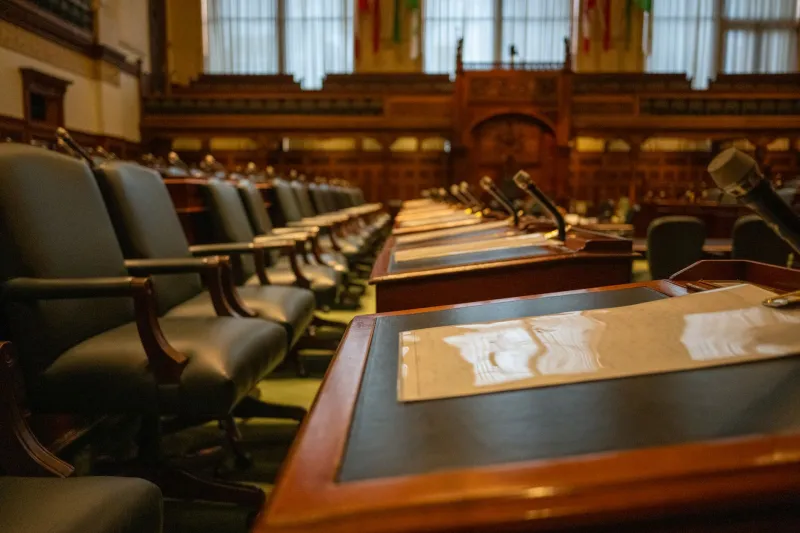
Two Minutes at the Microphone: A Field Guide to Public Comment That Actually Lands

There is a particular sound that fills a council chamber around 7:40 p.m., right after item four has been read aloud for the second time. It is the sound of a resident leaning into a microphone, gripping a printed speech with both hands, and beginning: 'I'll be brief.' Twenty minutes later, the sergeant at arms is still standing there.
I say this with affection. The people who show up are the ones keeping the whole thing running. But there is a wide gap between showing up and being heard, and that gap is mostly about understanding what the room is actually for.
The clock is the whole game
Most councils give each speaker two or three minutes on non-agenda items, and often less on a specific public hearing. That is not an insult to your cause. It is the only way a meeting with forty speakers ends before midnight, and the members are usually going to work the next morning like everyone else.
The timer is your friend once you accept it. Two minutes is roughly 250 to 300 spoken words. That is enough for a name, a problem, a number, and an ask. It is not enough for a history of the country.
What the dais actually does with your testimony
Here is the useful secret: public comment is not a debate, and the council is not the judge. Testimony usually gets used three ways.
To gauge heat. Members want to know whether an item is a two-email issue or a forty-voicemail issue. Volume matters, but intensity per speaker matters more than head count.
To harvest facts. Staff memos are thorough but not omniscient. A resident who says the bus stop at Fifth and Main has no shade and three riders with walkers is handing the council something staff did not have. That gets repeated back later, often by the member you least expected.
To build a record. Every comment is part of the file. If a decision gets challenged later, or an item comes back after an election, the testimony is still there. You are not performing for the room. You are writing yourself into the minutes.
A structure that fits in two minutes
Stand up, take a breath, and use this shape.
Name and place. 'My name is ___ and I live on ___ Street in ___ Ward.' That is ten seconds and it tells the room whose neighbor you are.
The ask, up front. One sentence. 'I am asking you to fund the sidewalk on Oak between Second and Seventh in this year's capital plan.' Front-load it, because someone in the room has heard seven versions of this and needs to know your version now.
One piece of evidence. A number, a date, a document number, a photograph you are handing to the clerk. One. Not nine.
What happens to people. This is the part that changes votes. 'Two kids in my building walk in the street to get to the bus.' Concrete beats abstract every time.
The ask again. 'Again: fund the Oak Street sidewalk.' Then step back, say thank you, and let the next person speak.
Bring three paper copies. Give one to the clerk. Ask for it to be entered into the record and note the item number in your remarks. Clerks remember the people who make their paperwork easier.
Things that reliably backfire
Reading a national argument into a local record. The council cannot do anything about the thing that is on cable news, and members know it. Make your point land on something they can actually vote on.
Naming and attacking a staff member. Staff cannot respond from the dais, and the members know them better than they know you. You have just made the human being who controls the timeline into your opponent.
Asking questions designed to trap a member. You will get a non-answer or an adjournment. If you have a real question — a date, a budget line, a policy — send it to the clerk in writing a week earlier and ask for it to be part of the record.
Saying 'with all due respect' and then not being due any respect. Everyone in the room has heard that phrase before and knows what follows.
Assuming a chorus is stronger than a summary. If fifteen people share your point, fifteen speakers dilute each other and eat the room's patience. Better: one speaker, fifteen names on a clipped-together page, and a line in the remarks noting how many neighbors signed.
The part almost nobody does
Stay. Stay for the item after yours, the consent calendar, the argument about the truck repair contract. Watch how the votes are actually cast rather than how the speeches sounded. Notice which member asks follow-up questions and which one has already decided.
Then talk to the person who spoke before you. You two have more in common than either of you has with anyone on the dais, and next month you will both be back.
Come back. This is the underrated one. Regulars get recognized. Recognition turns into questions like 'Did you get a look at the revised plan?' That is leverage, and it does not come from one brilliant speech. It comes from appearing a sixth time with the same folder.
Listening is the skill nobody brags about
We are trained to treat civic participation as a contest with a winner. It is better understood as a long-running conversation in a room with bad acoustics and folding chairs.
The microphone does not make you a debater. It makes you one more neighbor with a turn to talk, and the meeting will go on for years after your two minutes are up. The people who are heard are rarely the loudest. They are the ones who said something specific, wrote it down, and came back the next month to ask how it went.